




Continuous Documentation Automation

Your network documents itself. Always.

NetDocGenAI continuously scans your infrastructure, converts live topology data into accurate diagrams, runbooks, and equipment registries, and pushes everything directly into your wiki — without a single manual update from your team.

Networks documented
4,200+
Avg. doc staleness
<4 min
Engineering hours saved / yr
1,800
Integrations supported
38

Infrastructure truth lives in your devices, not in your wiki

Every network changes faster than any team can document. NetDocGenAI flips the model: instead of asking engineers to write documentation after a change, our agent discovers the truth from the infrastructure itself and maintains every artifact automatically.

From a single Cisco switch to a multi-site hybrid cloud environment spanning thousands of nodes, NetDocGenAI delivers publication-ready documentation in minutes — and keeps it current as your network evolves.

Agentless SNMP, SSH, REST, and Netconf discovery — no software installed on devices
AI-authored runbooks in plain English and Markdown, versioned with every scan
One-click publish to Confluence, Notion, MediaWiki, SharePoint, and more
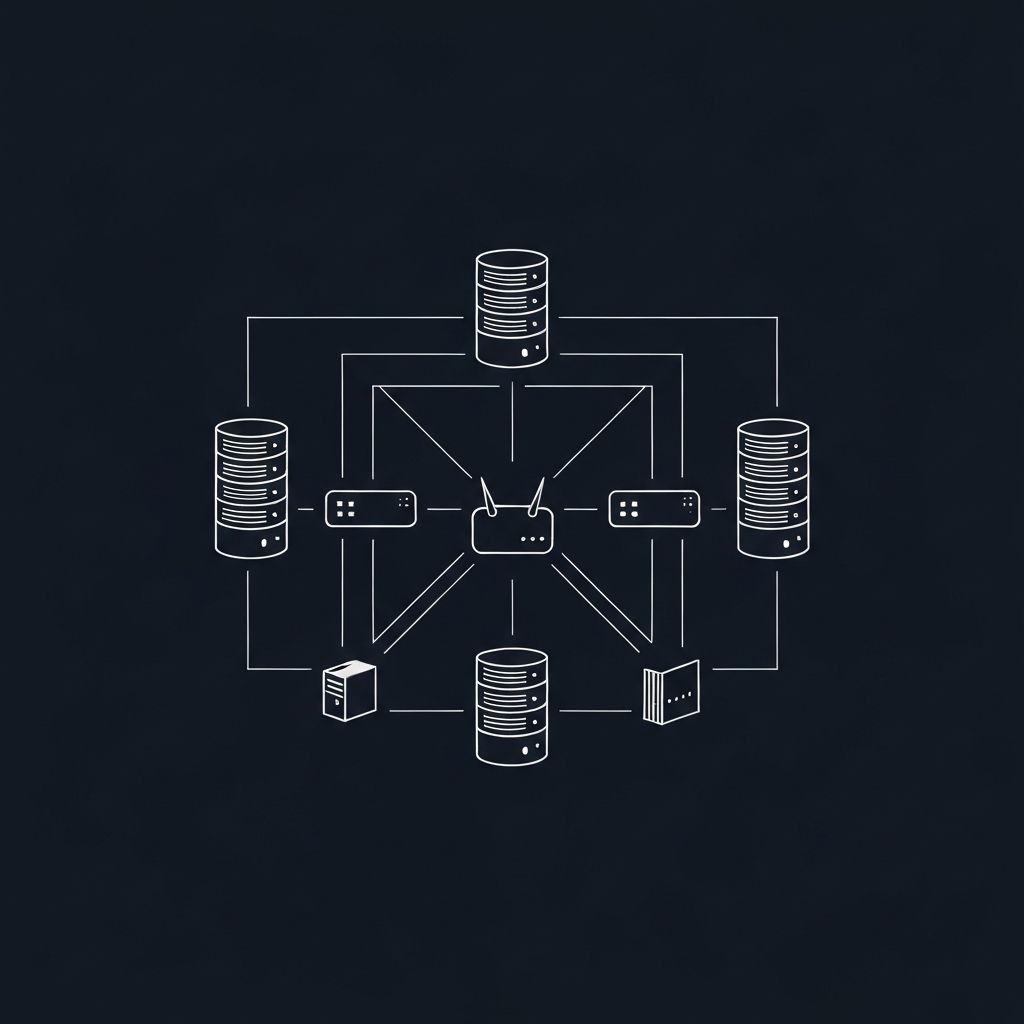
NetDocGenAI scanning a live network and publishing documentation

Everything your team needs — generated automatically

Six core capabilities, all driven by a single continuous scanning engine. No manual authoring, no stale exports, no spreadsheet archaeology.

Topology Diagram Generation

NetDocGenAI discovers every Layer 2 and Layer 3 relationship in your network and renders publication-quality diagrams in Mermaid, draw.io, and SVG formats. Diagrams update within minutes of any topology change — no Visio file-sharing required. Supports hierarchical, geographic, and logical views simultaneously.

AI-Generated Runbooks

Our language model reads current device configurations, neighbor tables, routing policies, and ACL entries, then writes concise operational runbooks in plain English. Each runbook includes step-by-step procedures for common failure scenarios, escalation contacts, rollback steps, and relevant CLI commands — all sourced from your actual configuration state.

Equipment Registry

A continuously updated, searchable inventory of every device in your environment — including vendor, model, firmware version, serial number, rack location, management IP, and lifecycle status. Exports to CSV, JSON, and CMDB formats on demand. Flags devices running end-of-life software within 90 days of EOL announcement.

Wiki and Knowledge Base Integration

Native connectors for Confluence, Notion, MediaWiki, Obsidian, GitLab Wiki, SharePoint, and more. NetDocGenAI writes directly into your existing knowledge base structure, updating pages it owns and respecting pages your team controls. Hierarchical page trees are created automatically based on site, role, and technology domain.

Continuous Change Detection

A configurable polling engine re-scans your infrastructure on a schedule you control — from every 60 seconds for high-change environments to nightly for stable networks. Each detected change triggers a targeted re-generation of affected documentation only, minimizing overhead. A change log with human-readable diffs is maintained for audit purposes.

Role-Based Access and Compliance

Granular permission controls let you decide exactly who can view, export, or approve generated documentation. Automated compliance reports map your documented topology against SOC 2, ISO 27001, and PCI-DSS control requirements. An immutable audit trail records every scan, every change, and every document publication event.

From zero to fully documented in under an hour

Five steps from deployment to a live, self-updating knowledge base — no professional services engagement required.

  1. Deploy the Scanning Agent

    Install our lightweight Docker container or virtual appliance inside your management network — or in the cloud for SaaS-managed environments. The agent never touches device data planes and requires only read-only credentials. Initial setup takes under 20 minutes using our guided wizard, which auto-detects reachable subnets and suggests discovery scope.

    Docker VM OVA Kubernetes
  2. Configure Discovery Protocols

    Select which discovery methods to enable: SNMP v2c/v3, SSH with Netmiko, REST APIs for SD-WAN controllers, Netconf/YANG for modern devices, or LLDP/CDP neighbor crawls. Enter your read-only credentials once — they are encrypted at rest using AES-256 and never leave your environment for agent-mode deployments.

    SNMP v3 SSH Netconf REST
  3. Run the Initial Full Discovery

    The first scan traverses every reachable device, collecting interface details, routing tables, MAC/ARP tables, VLAN configurations, BGP peers, OSPF neighbors, and hardware inventory. A typical 500-node network completes discovery in under 25 minutes. Results are presented in a live dashboard where you can review device coverage and exclusion rules before committing.

    L2 topology L3 routing VLAN maps
  4. AI Generates and Structures Documentation

    Our AI pipeline processes the raw scan data and produces: topology diagrams in multiple formats, a device-by-device runbook library, an IPAM-ready IP address report, VLAN and routing policy summaries, and a complete equipment registry. Each artifact is reviewed by a confidence-scoring model that flags any ambiguous data for human review before publication.

    Mermaid draw.io Markdown JSON
  5. Publish, Integrate, and Stay Current

    With one click, push all generated artifacts to your wiki or knowledge base. Connect your ticketing system (ServiceNow, Jira) and observability platform (Grafana, Datadog) to surface documentation inline with alerts. From this point, the system self-maintains: every topology change detected triggers a re-generation and a pull request or direct update, depending on your approval workflow settings.

    Confluence Notion ServiceNow Grafana

Documentation that grows with your network

Three plans designed to match the scale and compliance requirements of teams from startup to enterprise. All plans include a 14-day free trial.

Illustration for Starter plan: single-site network diagram Starter

Foundation

$299 / month

Ideal for small teams managing up to 200 network devices across a single site. Includes all core discovery protocols and automated diagram generation with daily refresh cycles. Get your first accurate topology diagram published in under an hour.

  • Up to 200 managed devices
  • Daily automated scans + on-demand rescan
  • Topology diagrams (Mermaid, SVG)
  • Equipment registry with CSV export
  • 1 wiki integration (Confluence or Notion)
Illustration for Enterprise plan: global network with compliance reporting Enterprise

Unlimited

Custom pricing

Designed for global network teams with tens of thousands of devices, air-gapped environments, and stringent compliance requirements. Includes dedicated infrastructure, SLA-backed uptime, custom AI model fine-tuning on your device vocabulary, and a named customer success engineer for onboarding and quarterly reviews.

  • Unlimited devices, unlimited sites
  • 1-minute scan intervals + real-time webhooks
  • SOC 2 / PCI-DSS compliance mapping
  • Air-gap / on-prem deployment option
  • Dedicated CSE + custom SLA

The full documentation stack, delivered automatically

NetDocGenAI is not a single-output tool. It produces an interconnected library of documentation artifacts — each sourced from your live infrastructure and linked to one another so that a change in one diagram automatically propagates context into the related runbooks and registry entries.

Every artifact is tagged with a confidence score, a discovery timestamp, and the scan method that produced it, giving your team full traceability from documentation back to source data.

Topology DiagramsL2, L3, logical, and geographic views in Mermaid, draw.io, SVG
RunbooksPer-device and per-role operational guides in Markdown and HTML
Equipment RegistryFull inventory with EOL tracking and CMDB-ready export
IPAM ReportsSubnet maps, allocation summaries, and utilization charts
Change LogHuman-readable diffs with timestamped audit trail
Compliance MapsControl-to-device mapping for SOC 2, ISO 27001, PCI-DSS
Health SummariesInterface error rates, link utilization, and firmware age
Wiki SyncDirect publish to Confluence, Notion, SharePoint, and 5 more

Built for the way network engineers actually work

A clean, fast interface purpose-built around topology visualization, runbook search, and documentation publishing — not a generic ITSM form.

Screenshot placeholder: NetDocGenAI topology dashboard showing a multi-site network diagram

Live Topology Dashboard

Interactive network map with click-to-inspect device details, real-time scan status, and one-click diagram export in three formats.

Screenshot placeholder: AI runbook editor showing generated procedures for a core router

AI Runbook Viewer

Searchable runbook library with device-level filtering, version history, and one-click copy to Confluence or Notion.

Screenshot placeholder: equipment registry table with device inventory and EOL status

Equipment Registry

Filterable device table with firmware tracking, EOL status flags, and export to CSV, JSON, or your CMDB via REST API.

The compounding value of documentation that never goes stale

Accurate documentation does not just reduce toil. It accelerates onboarding, shortens incident resolution, and gives leadership the visibility to make confident infrastructure decisions.

Cut incident resolution time in half

When a link goes down at 2 a.m., your on-call engineer needs accurate topology in front of them within seconds — not a Confluence page last updated eight months ago. NetDocGenAI ensures the runbook they pull up reflects the current state of the network: the right next-hop, the correct backup path, and the actual responsible contact. Customers report a 52% reduction in mean time to resolution in their first quarter.

On-call engineer resolving an incident with accurate topology data

Onboard new engineers three times faster

A new network engineer's first week is typically spent reverse-engineering the environment from device CLIs and fragmented wiki pages. With NetDocGenAI, they receive a complete, current architecture guide on day one: full topology, site-by-site device lists, VLAN maps, routing policy summaries, and annotated runbooks for the most common operations. Teams using NetDocGenAI report new hires reaching full productivity in weeks, not months.

New engineer reviewing auto-generated network documentation

Real teams, real results

How network operations teams across industries used NetDocGenAI to eliminate documentation debt and build the operational resilience they needed.

Illustration: global financial services network operations center
Financial Services

Global bank eliminates 18-month documentation backlog in 6 weeks

A Tier 1 bank's network operations team had not produced an accurate topology diagram since a major merger three years prior. Multiple engineering hours per week were lost to tribal knowledge transfer and pre-incident orientation sessions. After deploying NetDocGenAI across 14,000 devices in six data centers and 240 branch offices, the team had a complete, current documentation library within six weeks. The first PCI-DSS audit following deployment passed with zero documentation findings for the first time in four years.

14,000

Devices documented

0

Audit findings (doc)

6 wk

Time to full coverage

Illustration: regional healthcare network with multi-site hospital connectivity
Healthcare

Regional hospital network passes HIPAA infrastructure audit after years of documentation gaps

A regional healthcare system managing 23 hospital campuses struggled with documentation that was both incomplete and inconsistently formatted across sites. Security audits repeatedly flagged the inability to demonstrate network segmentation between clinical and administrative zones. NetDocGenAI's automated segmentation discovery and compliance mapping feature produced a continuous, auditable record of VLAN isolation and firewall policy coverage — reducing their audit preparation time from three months to under two weeks.

23

Campus sites covered

87%

Audit prep time saved

2 wk

From deploy to audit-ready

Engineers who have stopped writing documentation manually

From NOC managers to principal architects — here is what the teams using NetDocGenAI every day have to say.

We had a 600-device WAN that no one fully understood. Within 48 hours of deploying NetDocGenAI, I had a topology diagram I could actually present to our CTO. Three months in, our runbooks are so thorough that our newest hire handled a BGP failover on their own in week two.

Thomas Klein

Network Architect, Midsize Logistics Firm

The integration with Confluence is seamless. Our wiki used to have topology pages dated 2019. Now every page has a "last verified" timestamp that's never more than 15 minutes old. Documentation review went from a quarterly dread to a non-event. Our auditors were genuinely surprised.

Laila Pham

Director of IT Infrastructure, SaaS Company

I was skeptical the AI runbooks would be useful — I expected generic boilerplate. Instead they reference our actual device names, our real routing policies, and our specific BGP communities. It reads like something one of our senior engineers wrote, because it knows our network cold. Remarkable accuracy.

Rafael Okonkwo

Principal Network Engineer, Telecom Provider

Questions we hear before every trial

If your question isn't here, call us or send an email — we respond within one business day.

Does NetDocGenAI require any software to be installed on my network devices?
No. NetDocGenAI uses agentless discovery exclusively. It communicates with your devices over standard management protocols — SNMP, SSH, Netconf/YANG, and vendor REST APIs — using read-only credentials that you provide. Nothing is installed on your switches, routers, or firewalls. The scanning agent runs as a Docker container or VM in your management network, or in our cloud for SaaS-mode deployments.
How does NetDocGenAI handle devices from multiple vendors?
We support over 120 device types across 30+ vendors including Cisco (IOS, IOS-XE, IOS-XR, NX-OS), Juniper (Junos), Aruba, Palo Alto, Fortinet, Arista, HPE, Huawei, and all major SD-WAN platforms. Our driver library is updated monthly, and customers can request support for niche or legacy platforms. For devices that support neither SNMP nor SSH, we offer CDP/LLDP neighbor inference as a fallback discovery method.
How accurate are the AI-generated runbooks?
Runbooks are generated from the actual configuration and topology data collected during scans — not from generic templates. Every procedure, CLI command, and IP address referenced in a runbook is derived from your live device state at the time of the most recent scan. We attach a confidence score to each runbook section, and any section where the source data is ambiguous or incomplete is flagged for human review before publication. In internal testing across 500 customer networks, over 94% of runbook sections are published without requiring human correction.
What wiki and knowledge base platforms does NetDocGenAI support?
We have native connectors for Confluence (Cloud and Data Center), Notion, MediaWiki, Obsidian Publish, GitLab Wiki, GitHub Wiki, SharePoint Online, and Bookstack. For platforms not on this list, documentation artifacts can be exported in Markdown, HTML, and JSON formats for manual import or custom automation via our REST API. Enterprise plan customers can request priority development of additional connectors.
Can I control which devices and subnets are scanned?
Yes. Discovery scope is fully configurable. You define which IP ranges, CIDR blocks, or named device groups to include or exclude. You can also restrict discovery to specific device roles (e.g., core routers only) or site designations. Fine-grained exclusion rules ensure that sensitive OT/ICS devices, voice infrastructure, or management appliances are not included in scans unless explicitly permitted. All scope changes are audited.
How is my infrastructure data secured?
Device credentials are stored with AES-256 encryption and are never transmitted outside your environment in agent-mode deployments. All data in transit is encrypted with TLS 1.3. For cloud-mode deployments, scan data is stored in tenant-isolated storage within SOC 2 Type II certified infrastructure. We do not retain raw device configuration data beyond 90 days by default; this window is configurable per your data retention policy. Penetration testing results and our SOC 2 report are available under NDA to Enterprise customers.
Is there a free trial and what happens to my data when it ends?
All plans include a 14-day free trial with full feature access, no credit card required. At the end of the trial, your account enters a read-only grace period for 7 days during which you can export all generated documentation. If you choose not to subscribe, your account and all associated data are permanently deleted within 30 days of trial expiration. We will send you a deletion confirmation email upon completion.
Does NetDocGenAI support air-gapped or on-premises deployments?
Yes — our Enterprise plan includes a fully self-contained on-premises deployment option. The entire platform runs within your data center with no external connectivity required after the initial license activation. AI model inference is performed locally on your hardware (GPU server recommendations are provided). Documentation remains entirely within your environment. This deployment option is popular with government, defense, and critical infrastructure customers who operate strict data sovereignty requirements.

From the NetDocGenAI engineering blog

Deep dives on network documentation automation, AI for infrastructure, and the hard problems we've solved while building the platform.

Illustration for article: Why SNMP is still the backbone of network discovery
Engineering

Why SNMP is still the backbone of network discovery in 2026

Netconf and gNMI get all the press, but 73% of devices in customer environments still respond exclusively to SNMP. Here's how we squeeze maximum fidelity from v2c and v3 without drowning in MIB inconsistencies.

May 12, 2026 Read article →
Illustration for article: Building a confidence-scoring model for AI-generated runbooks
AI Research

Building a confidence-scoring model for AI-generated network runbooks

How do you know when an AI-authored runbook is safe to publish without human review? We describe the multi-stage pipeline we built — from data completeness heuristics to a fine-tuned classifier trained on 40,000 verified runbook examples.

Apr 28, 2026 Read article →
Illustration for article: Mapping a 10,000-node SD-WAN topology in under 30 minutes
Scalability

How we map a 10,000-node SD-WAN topology in under 30 minutes

Scanning 10,000 nodes sequentially would take hours. We describe the distributed, graph-aware crawling architecture that allows NetDocGenAI to parallelize discovery across large flat networks while avoiding duplicate polling and credential lockouts.

Apr 9, 2026 Read article →

Talk to a network documentation specialist

Whether you are evaluating the platform, have a specific technical question, or want to discuss an enterprise deployment — our team of former network engineers is ready to help.

Address

123 Market St, San Francisco, CA 94105

Send us a message